

Silicone Products
Silicone Products Molded Rubber Products
What Are Custom Molded Rubber Products?
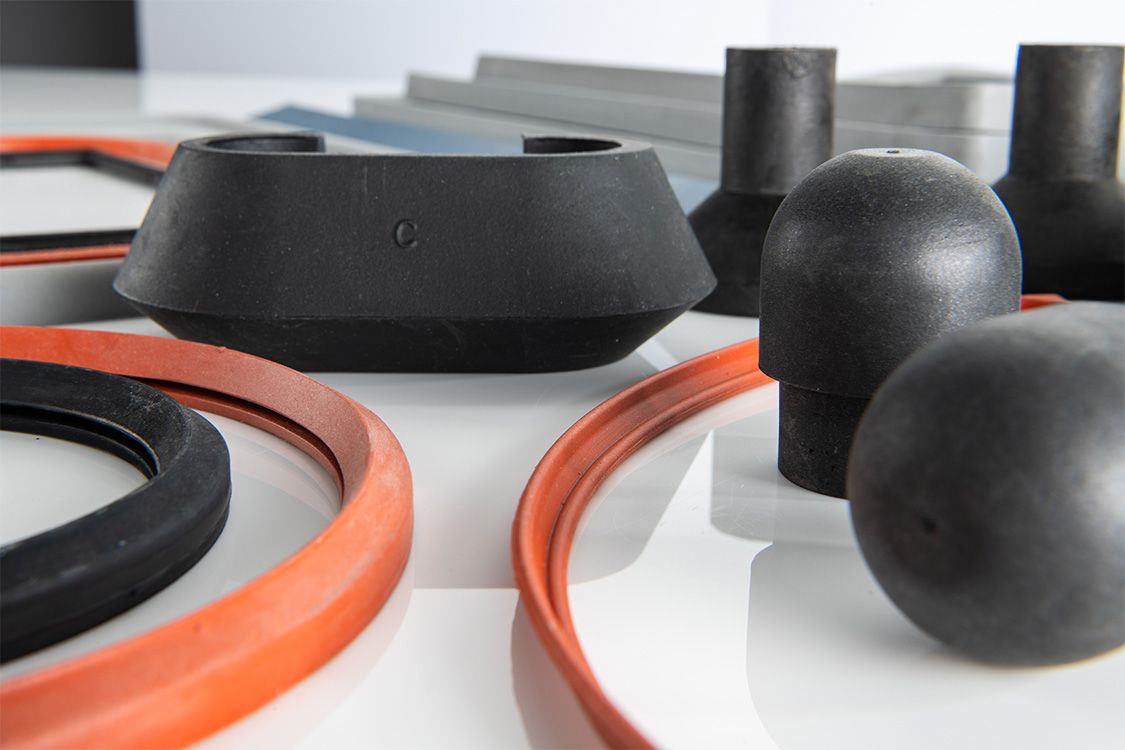
Custom molded rubber products are elastomer components formed inside a precision mold to create application-specific shapes, dimensions, and performance characteristics. Rubber molding is ideal for components that require three-dimensional geometry, integrated features, controlled dimensions, or shapes that cannot be produced efficiently through extrusion or flat-sheet cutting.
Bellofram Elastomers manufactures custom molded rubber and silicone components ranging from simple plugs and caps to intricate, multi-cavity parts. Available materials include solid silicone, closed-cell silicone sponge, nitrile (NBR), fluorosilicone, and other elastomer formulations selected to meet specific sealing, cushioning, insulating, protective, chemical, and environmental requirements.
Key Takeaways
- Custom rubber molding creates three-dimensional elastomer components around application-specific geometry and performance requirements.
- Bellofram Elastomers molds both solid silicone and closed-cell silicone sponge.
- Additional elastomer options include nitrile (NBR), fluorosilicone, and other custom formulations.
- Components can range from simple plugs and caps to intricate, multi-cavity molded parts.
- In-house engineering and tooling capabilities support development of custom molded geometries.
- Silicone formulations can provide temperature performance from -85°F to +400°F depending on material selection.
- FDA-grade, NSF 51 certified, UL 94 V-0, and UL HB material options are available.
- Applications include aerospace, medical, food processing, transportation, electronics, industrial equipment, and other demanding environments.
Why Choose Custom Molded Rubber Components?
Rubber molding provides greater geometric freedom than processes designed around continuous profiles or flat sheet material. Components can incorporate curves, cavities, variable thicknesses, sealing features, mounting details, and other three-dimensional characteristics directly into the molded part.
This allows engineers to design an elastomer component around the application instead of adapting an existing standard profile or combining multiple separate parts.
| BENEFIT | WHY IT MATTERS |
|---|---|
| Complex 3D Geometry | Supports application-specific shapes, cavities, contours, and features that cannot be produced as simple continuous extrusions or flat-cut parts. |
| Dimensional Consistency | Controlled molding processes help maintain repeatable dimensions and part geometry throughout production. |
| Custom Material Selection | Solid silicone, silicone sponge, nitrile, fluorosilicone, and other elastomers can be selected around mechanical, chemical, thermal, and environmental requirements. |
| Integrated Part Features | Functional details can be incorporated directly into the molded geometry, helping reduce separate components and downstream assembly. |
| Application-Specific Performance | Material formulation, hardness, geometry, and construction can be tailored to sealing, cushioning, insulating, and protective requirements. |
| Specialty Formulations | FDA-grade, NSF 51 certified, flame-retardant, and other specialty elastomer options are available for applicable requirements. |
Molded Rubber Material Options
Material selection is one of the most important considerations when developing a custom molded elastomer component. The appropriate rubber depends on operating temperature, media exposure, required flexibility, chemical resistance, environmental conditions, and mechanical performance.
| MATERIAL | TYPICAL ADVANTAGES |
|---|---|
| Solid Silicone | Provides flexibility, tear strength, thermal stability, and long-term mechanical durability for demanding molded components. |
| Closed-Cell Silicone Sponge | Provides greater compressibility and low water absorption for cushioning, sealing, and protective applications. |
| Nitrile (NBR) | Commonly selected for applications requiring resistance to oils, fuels, and petroleum-based fluids. |
| Fluorosilicone | Provides silicone-like environmental and temperature performance with improved resistance to fuels, oils, and certain chemicals. |
| Custom Elastomer Formulations | Additional elastomer compounds can be selected or tailored around specific temperature, chemical, environmental, and mechanical requirements. |
Molded Solid Silicone vs. Molded Silicone Sponge
Bellofram Elastomers can mold both dense silicone rubber and closed-cell silicone sponge. The right construction depends largely on the required firmness, compressibility, gap accommodation, and mechanical performance of the finished component.
| FEATURE | MOLDED SOLID SILICONE | MOLDED SILICONE SPONGE |
|---|---|---|
| Construction | Dense, non-cellular silicone rubber. | Closed-cell silicone sponge. |
| Density | Denser and heavier, solid elastomer construction. | Lighter-weight cellular construction. |
| Compression | Firmer and less compressible, providing greater mechanical stability and sealing force. | Highly compressible and suited for lower closure-force sealing and cushioning. |
| Gap Filling | Best suited where a firm, dimensionally stable molded component is required. | Well suited for uneven gaps and mating surfaces requiring greater conformability. |
| Typical Priority | Mechanical durability, dense sealing, firmness, tear strength, and dimensional stability. | Compression sealing, cushioning, gap filling, insulation, and low closure force. |
Custom Molded Rubber Shapes and Components
Rubber molding provides the flexibility to manufacture both straightforward parts and highly customized components with features built directly into the finished geometry.
| COMPONENT TYPE | TYPICAL USE |
|---|---|
| Plugs | Sealing, closing, protecting, or isolating openings in equipment and assemblies. |
| Caps | Protective covering and sealing around component ends, fittings, connections, or exposed features. |
| Seals | Custom geometries designed to prevent leakage, contamination, or environmental intrusion. |
| Rubber Bullets | Custom molded elastomer projectiles or impact components manufactured to application-specific geometry, material, and performance requirements. |
| Cushioning Components | Absorb compression, impact, or vibration around equipment and sensitive assemblies. |
| Insulating Components | Provide thermal, environmental, or protective isolation between parts and assemblies. |
| Multi-Cavity Parts | Support complex designs incorporating multiple cavities, surfaces, or functional features in one molded component. |
| Custom Components | Engineered around customer-specific geometry, material, performance, and installation requirements. |
Standards and Specialty Molded Rubber Materials
Bellofram Elastomers offers molded elastomer options for applications with specific regulatory, food-equipment, and flammability requirements.
| OPTIONS | TYPICAL APPLICATION |
|---|---|
| UL 94 V-0 | Flame-sensitive applications requiring enhanced vertical-burn performance. |
| UL HB | Applications requiring horizontal-burn flammability performance. |
| NSF 51 | Food and beverage equipment requiring appropriate certified and FDA compliant materials. |
| Custom Formulations | Application-specific elastomer compounds tailored to performance, environmental, chemical, or mechanical requirements. |
Common Applications for Custom Molded Rubber Products
Custom molded rubber components are used across applications where standard elastomer profiles cannot provide the required geometry, fit, or combination of mechanical and environmental performance.
| APPLICATION | HOW MOLDED RUBBER COMPONENTS HELP |
|---|---|
| Aerospace | Provides custom sealing, cushioning, insulating, and protective components for demanding temperature and environmental conditions. |
| Medical Equipment | Supports custom cushioning, sealing, and protective applications using application-appropriate elastomer formulations. |
| Food Processing Equipment | FDA-grade and NSF 51 certified material options can support applicable regulated equipment requirements. |
| Transportation | Provides molded seals, cushions, protective components, and vibration-control parts exposed to demanding operating conditions. |
| Electronics | Provides custom insulation, cushioning, environmental protection, and sealing around sensitive components. |
| Industrial Equipment | Supports sealing, cushioning, isolation, and protection in machinery requiring custom elastomer geometry. |
| Custom OEM Assemblies | Allows elastomer geometry, material, and functionality to be engineered directly around the surrounding product design. |
Molded Rubber vs. Extruded Rubber Components
Molding and extrusion are complementary manufacturing processes. Extrusion produces a continuous cross-sectional profile, while molding creates an individual three-dimensional component inside a defined mold cavity.
| FEATURE | MOLDED RUBBER | EXTRUDED RUBBER |
|---|---|---|
| Construction | Material is formed inside a mold cavity to produce an individual three-dimensional component. | Material is continuously formed through a die to produce a consistent cross-sectional profile. |
| Density | Can use solid or sponge elastomer constructions depending on material and application requirements. | Can use solid or sponge elastomer constructions depending on the extrusion material. |
| Compression | Can be tailored through material selection, part geometry, and molded thickness. | Can be tailored through material selection, profile geometry, and extrusion dimensions. |
| Gap Filling | Ideal when a three-dimensional molded geometry must fit a defined cavity, surface, or assembly. | Ideal for continuous gaps requiring a consistent cross-sectional sealing profile. |
| Typical Priority | Complex 3D geometry, integrated features, individual components, and dimensional control. | Continuous seals, long lengths, consistent profiles, and custom cross-sectional geometry. |
For custom extrusions, explore our Silicone Profiles and Silicone Sponge Profiles.
Molded Rubber vs. Flash Cut Rubber Components
While both molded rubber and flash cut rubber components are highly customizable and well suited for complex shapes, the best process depends on whether the application requires three-dimensional geometry or a flat, precision-cut part. Molded components can incorporate three-dimensional geometry, while flash cutting creates flat components directly from sheet material without hard cutting dies.
| FEATURE | MOLDED RUBBER | FLASH CUT COMPONENTS |
|---|---|---|
| Construction | Formed inside a mold to produce three-dimensional component geometry. | Digitally cut from flat elastomer sheet material. |
| Density | Determined by the selected solid or sponge silicone molding compound. | Determined by the selected sheet material. |
| Compression | Can be tailored through three-dimensional geometry, material, and molded thickness. | Determined primarily by sheet material, thickness, and formulation. |
| Gap Filling | Supports three-dimensional shapes designed around complex mating surfaces and assemblies. | Best suited for flat sealing surfaces and two-dimensional component geometries. |
| Typical Priority | Complex geometry, integrated features, production components, and repeatable molded dimensions. | Rapid prototypes, flat parts, intricate cutouts, design changes, and tooling-free cutting. |
For custom flat silicone parts produced without tooling, explore our Flash Cut Silicone capabilities.
Custom Mold Design and Tooling
The performance of a molded rubber component depends on more than material selection. Mold design must account for finished geometry, dimensional requirements, elastomer flow, part removal, intended function, and production requirements.
Bellofram Elastomers’ in-house engineering and tooling expertise allows molds to be developed around customer-specific component designs and performance needs.
Custom molding projects can consider:
- Component geometry
- Dimensions and tolerances
- Material selection
- Solid or sponge construction
- Temperature exposure
- Chemical and media exposure
- Compression requirements
- Sealing or cushioning function
- Regulatory or flammability requirements
- Production quantities
When Should You Choose a Custom Molded Rubber Part?
A molded rubber component may be the right solution when your application requires geometry or functionality that cannot be achieved efficiently with a continuous extrusion or flat sheet component.
Custom molded rubber may be ideal when:
- A three-dimensional elastomer shape is required.
- The part includes cavities, contours, or integrated features.
- A plug, cap, seal, cushion, insulator, or protective component is needed.
- Solid silicone or closed-cell silicone sponge construction is required.
- Nitrile, fluorosilicone, or another elastomer is better suited to the operating environment.
- Temperature extremes, chemicals, vibration, or environmental exposure must be addressed.
- UL 94 V-0 or UL HB material performance is required.
- FDA-grade or NSF 51 certified material is needed.
- Repeatable dimensions and finished geometry are important.
Why Choose Bellofram Elastomers for Molded Rubber Products?
Bellofram Elastomers combines elastomer material expertise, in-house engineering, tooling development, and molding capabilities to support custom rubber components from design through production.
Bellofram Elastomers offers:
- Solid silicone molding.
- Closed-cell silicone sponge molding.
- Nitrile, fluorosilicone, and additional elastomer options.
- Simple through complex three-dimensional geometries.
- Custom plugs, caps, seals, cushioning components, and multi-cavity parts.
- In-house engineering and tooling expertise.
- Silicone material options capable of -85°F to +400°F depending on formulation.
- UL 94 V-0 and UL HB flame-retardant options.
- FDA-grade and NSF 51 certified material options.
- Custom formulations for application-specific performance.
- U.S.-based manufacturing and technical support.
Frequently Asked Questions About Custom Molded Rubber Products
What is a custom molded rubber product?
A custom molded rubber product is an elastomer component formed inside a mold to create a specific three-dimensional shape. Rubber molding can produce components with custom contours, cavities, thicknesses, and other features designed around an application.
What materials can Bellofram Elastomers mold?
Bellofram Elastomers molds materials including solid silicone, closed-cell silicone sponge, nitrile (NBR), fluorosilicone, and other elastomer formulations selected according to application requirements.
What types of molded rubber parts can Bellofram Elastomers manufacture?
Bellofram Elastomers can manufacture molded rubber products ranging from simple plugs and caps to seals, cushioning components, insulating parts, protective components, and intricate multi-cavity designs.
What is the difference between molded solid silicone and molded silicone sponge?
Solid silicone is non-cellular and provides greater firmness, tear strength, and mechanical stability, while closed-cell silicone sponge provides lower density, greater compressibility, and low water absorption for cushioning and lower closure-force sealing applications.
What temperature range can molded silicone components withstand?
Bellofram Elastomers offers molded silicone formulations capable of resisting temperatures from -85°F to +400°F depending on the selected material and formulation.
What is the difference between molded rubber and extruded rubber?
Molded rubber is formed inside a mold to create an individual three-dimensional component, while extruded rubber is continuously formed through a die to produce a consistent cross-sectional profile. Molding is generally better suited for complex 3D components, while extrusion is ideal for continuous seals and profiles.
What is the difference between molded rubber and flash cut rubber?
Molded rubber can incorporate complex three-dimensional geometry, while flash cut components are cut from flat sheet material. Flash cutting is useful for rapid prototypes and flat shapes without hard cutting tooling, while molding is better suited for finished components requiring three-dimensional features.
Are flame-retardant molded rubber products available?
Yes. Bellofram Elastomers offers molded silicone formulations that comply with UL 94 V-0 or UL HB requirements for applicable flame-sensitive applications.
Are FDA-grade or NSF 51 molded silicone products available?
Yes. Bellofram Elastomers offers FDA-grade silicone and NSF 51 certified material options for applicable food processing and other regulated equipment applications.
Can Bellofram Elastomers develop tooling for a custom molded rubber part?
Yes. Bellofram Elastomers has in-house engineering and tooling expertise to develop molds around customer-specific geometry, dimensional, material, and performance requirements.
What industries use custom molded rubber products?
Custom molded rubber products are used in aerospace, medical, food processing, transportation, electronics, industrial equipment, and other applications requiring durable, flexible, precision-shaped elastomer components.
Can Bellofram Elastomers manufacture custom molded rubber components?
Yes. Bellofram Elastomers can tailor component geometry, elastomer type, formulation, solid or sponge construction, and other performance characteristics around specific application requirements.
Your Satisfaction is Our Focus!
Thank you for completing this form. Your interest in our products & services is highly valued, and we're excited to be considered for your needs. Rest assured, we will carefully review the information provided to offer a tailored solution. Our experts will work diligently to ensure you receive a timely and accurate quote. Should you have any questions or need further assistance, please feel free to contact us. We eagerly await the opportunity to serve you.