

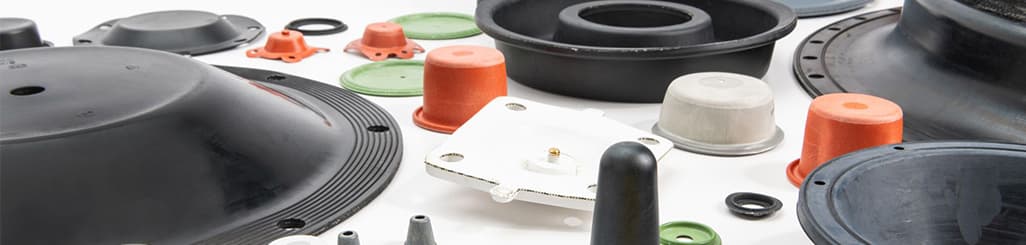
Diaphragm Products
Diaphragm Products Metal-Inserted Diaphragms
What Are Metal-Inserted Diaphragms?
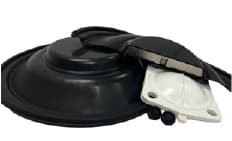
Metal-inserted diaphragms are custom molded elastomer components that combine the flexibility and sealing performance of rubber with the strength and dimensional stability of a rigid metal or engineered-plastic insert. During the molding process, the insert is fully or partially encapsulated within the elastomer to create a single bonded component.
Bellofram Elastomers manufactures custom rubber-to-metal diaphragms for valves, actuators, pumps, regulators, fluid control systems, and other mechanisms that require precise movement, structural support, and dependable sealing performance.
Key Takeaways
- Metal-inserted diaphragms combine elastomer flexibility with the rigidity of a metal or engineered-plastic insert.
- Inserts can be fully or partially encapsulated during the molding process.
- Integrated construction can eliminate secondary fastening, adhesive, or assembly steps.
- Metal inserts add dimensional stability and structural support while the elastomer provides sealing and flexibility.
- Material options include nitrile, silicone, FKM, and other custom elastomer compounds.
- Insert materials can include metal, engineered plastics, or other customer-specified materials.
- Common applications include valves, actuators, pumps, regulators, and fluid control systems.
- Geometry, thickness, elastomer formulation, and insert configuration can be customized.
Why Choose Metal-Inserted Diaphragms?
Metal-inserted diaphragms combine multiple functions into a single molded component. The insert provides rigidity and dimensional stability, while the surrounding elastomer provides flexibility, sealing capability, and environmental resistance.
Because the insert is molded directly into the diaphragm, the construction can eliminate separate fastening or adhesive assembly steps. This helps reduce component count, simplify assembly, and create a repeatable bonded interface between the rigid insert and flexible elastomer.
| BENEFIT | WHY IT MATTERS |
|---|---|
| Integrated Construction | Combines the diaphragm and rigid insert into one molded component, reducing the need for secondary assembly. |
| Improved Dimensional Stability | The insert provides structural support and helps maintain consistent part geometry during operation. |
| Reliable Bonding | Molding the insert directly into the elastomer creates a permanent bonded interface designed to minimize shifting or separation. |
| Reduced Component Count | Eliminating separate fasteners, adhesives, or attachment hardware can simplify assembly and reduce labor. |
| Repeatable Actuation | Stable insert positioning helps support consistent movement in pressure-responsive systems. |
| Custom Design Flexibility | Insert material, elastomer formulation, diaphragm geometry, thickness, and encapsulation can be tailored to the application. |
Metal-Inserted Diaphragm Material Options
Bellofram Elastomers offers multiple elastomer and insert options for rubber-to-metal diaphragm applications. Material selection depends on temperature, media exposure, chemical compatibility, pressure, structural requirements, and environmental conditions.
| MATERIAL | TYPICAL ADVANTAGES |
|---|---|
| Nitrile (NBR) | Commonly selected for applications requiring resistance to oils, fuels, and petroleum-based fluids. |
| Silicone | Provides flexibility and temperature stability for demanding operating environments. |
| FKM | Offers strong resistance to elevated temperatures, aggressive chemicals, oils, fuels, and corrosive fluids. |
| Metal Inserts | Provide rigidity, structural support, and dimensional stability within the molded diaphragm. |
| Engineered Plastic Inserts | Offer an alternative rigid insert option when weight, corrosion resistance, or application-specific requirements make plastic preferable. |
| Custom Material Combinations | Elastomer and insert materials can be selected to meet specific mechanical, chemical, thermal, and environmental requirements. |
Metal-Inserted vs. Standard Rubber Diaphragms
The primary difference between a metal-inserted diaphragm and a standard rubber diaphragm is the addition of a rigid insert within the molded elastomer. Metal-inserted designs provide built-in structural support, while traditional homogeneous diaphragms rely primarily on the elastomer for their performance.
| FEATURE | METAL-INSERTED DIAPHRAGM | STANDARD RUBBER DIAPHRAGM |
|---|---|---|
| Construction | Combines elastomer with a molded-in metal or engineered-plastic insert. | Constructed from elastomer alone or elastomer combined with fabric reinforcement. |
| Structural Support | Rigid insert provides integrated dimensional stability and support. | Structural characteristics depend on elastomer thickness and optional fabric reinforcement. |
| Assembly | Can integrate attachment or structural features directly into the molded component. | May require separate hardware or assembly depending on the application. |
| Part Alignment | Insert is molded into position to support consistent alignment and repeatable movement. | Alignment depends on the surrounding assembly and diaphragm mounting method. |
| Typical Priority | Structural stability, integrated assembly, precise actuation, and sealing. | Flexibility, pressure response, sealing, and simplified diaphragm construction. |
For applications requiring flexible pressure response without a rigid insert, explore our fabric reinforced single-coat diaphragms, fabric reinforced double-coat diaphragms, or homogeneous rubber diaphragms.
Common Applications for Metal-Inserted Diaphragms
Metal-inserted diaphragms are useful in mechanisms where a flexible sealing element must interact with or transfer movement through a rigid structural component.
| APPLICATION | HOW THE DIAPHRAGM HELPS |
|---|---|
| Valve Assemblies | Combines flexible sealing with a rigid insert for controlled, repeatable valve movement. |
| Actuators | Supports transfer of pressure-driven movement while maintaining structural alignment. |
| Pumps | Provides flexible sealing and controlled movement within repeated operating cycles. |
| Pressure Regulators | Supports precise movement and dimensional stability in pressure-control mechanisms. |
| Fluid Control Systems | Helps combine sealing, movement, and structural functions within one molded component. |
| Custom Mechanical Assemblies | Allows a rigid attachment or support feature to be incorporated directly into a flexible elastomer component. |
Custom Rubber-to-Metal Diaphragms
Bellofram Elastomers works with engineers and OEMs to develop metal-inserted diaphragm constructions tailored to specific mechanical and environmental requirements.
Inserts can be made from metals, engineered plastics, or other customer-specified materials and can be fully or partially encapsulated within the elastomer. Diaphragm shape, thickness, elastomer formulation, and insert configuration can also be customized to fit the surrounding assembly.
By integrating the insert during molding, Bellofram can create a bonded, repeatable component designed to reduce shifting, misalignment, or separation between materials.
When Should You Choose a Metal-Inserted Diaphragm?
A metal-inserted diaphragm may be the right solution when your application requires both flexible elastomer performance and integrated structural support.
Metal-inserted construction may be ideal when:
- A rigid attachment or structural element must be integrated into the diaphragm.
- Precise alignment and repeatable actuation are important.
- Secondary fastening or adhesive assembly steps should be reduced.
- Dimensional stability is critical to system operation.
- Rubber sealing and rigid mechanical support are required in the same component.
- A metal or engineered-plastic insert must be fully or partially encapsulated.
- Custom insert geometry or material combinations are needed.
If your application does not require a rigid insert, consider our fabric reinforced single-coat diaphragms or fabric reinforced double-coat diaphragms for added strength and pressure resistance.
For low-pressure applications requiring maximum flexibility without fabric reinforcement, explore our homogeneous rubber diaphragms.
Why Choose Bellofram Elastomers for Metal-Inserted Diaphragms?
Bellofram Elastomers combines elastomer material expertise with in-house molding and bonding capabilities to manufacture custom rubber-to-metal diaphragm assemblies.
Bellofram Elastomers offers:
- Metal and engineered-plastic insert options.
- Fully or partially encapsulated inserts.
- Nitrile, silicone, FKM, and custom elastomer formulations.
- Custom geometry, thickness, and insert configurations.
- Integrated molding that can reduce secondary assembly operations.
- Prototype and custom OEM diaphragm support.
- U.S.-based manufacturing in Newell, West Virginia.
Frequently Asked Questions About Metal-Inserted Diaphragms
What is a metal-inserted diaphragm?
A metal-inserted diaphragm is a custom molded elastomer component that incorporates a rigid metal or engineered-plastic insert within the rubber. The insert adds structural support and dimensional stability, while the surrounding elastomer provides flexibility and sealing performance.
How are metal inserts incorporated into rubber diaphragms?
The insert is placed into the mold and fully or partially encapsulated by the elastomer during molding. This process creates a bonded component and can eliminate the need for separate fastening or adhesive assembly steps.
What are metal-inserted diaphragms used for?
Metal-inserted diaphragms are commonly used in valves, actuators, pumps, pressure regulators, fluid control systems, and other mechanisms requiring flexible sealing combined with structural stability and repeatable movement.
What is the benefit of molding a metal insert directly into a diaphragm?
Molding the insert directly into the elastomer can reduce component count, simplify assembly, improve alignment, and create a repeatable bonded interface between the flexible diaphragm and rigid structural element.
Can plastic inserts be used instead of metal?
Yes. Bellofram Elastomers can incorporate engineered-plastic inserts as well as metal inserts and other customer-specified insert materials depending on the application's mechanical and environmental requirements.
What elastomer materials are available for metal-inserted diaphragms?
Bellofram Elastomers works with materials including nitrile, silicone, FKM, and other custom elastomer compounds. Material selection depends on operating temperature, media exposure, chemical compatibility, flexibility, and environmental requirements.
Can a metal insert be fully or partially encapsulated?
Yes. Metal or plastic inserts can be fully or partially encapsulated by the elastomer depending on the required geometry, attachment method, sealing needs, and surrounding assembly.
Can metal-inserted diaphragms be customized?
Yes. Bellofram Elastomers can customize diaphragm geometry, thickness, elastomer formulation, insert material, insert geometry, and the degree of encapsulation to meet specific application requirements.
What industries use metal-inserted diaphragms?
Metal-inserted diaphragms can be used in aerospace, automotive, medical, fluid handling, industrial control, and other applications requiring integrated sealing and structural support.
Are Bellofram Elastomers metal-inserted diaphragms made in the USA?
Bellofram Elastomers manufactures custom diaphragm products at its U.S. facility in Newell, West Virginia.
Your Satisfaction is Our Focus!
Thank you for completing this form. Your interest in our products & services is highly valued, and we're excited to be considered for your needs. Rest assured, we will carefully review the information provided to offer a tailored solution. Our experts will work diligently to ensure you receive a timely and accurate quote. Should you have any questions or need further assistance, please feel free to contact us. We eagerly await the opportunity to serve you.